
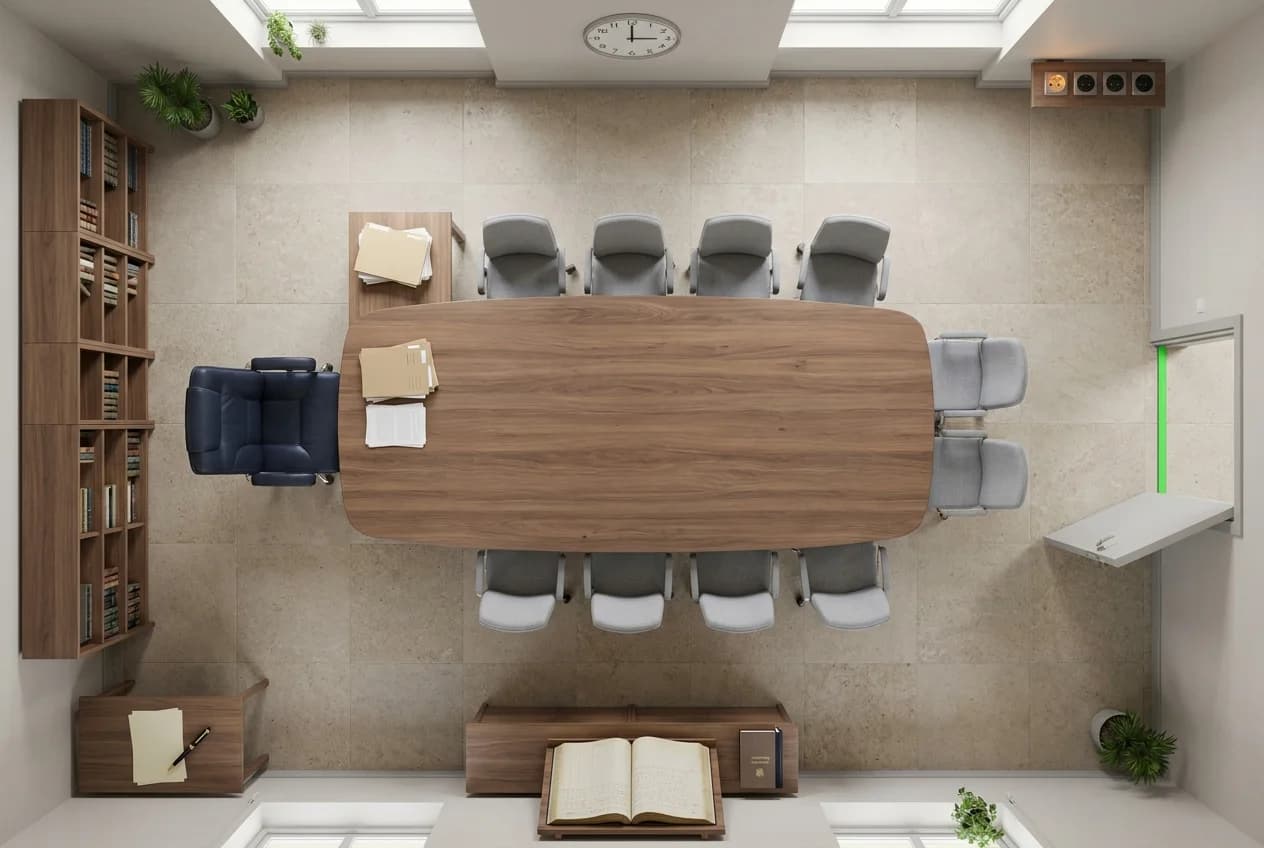
The first primer showed you the room assembled and one message passing through five of its parts. This page takes all eleven, one at a time, and asks the only question that makes a part worth paying for: what goes wrong without it?
The failures are not exotic. A loop that never ends. An adviser’s draft sent as the company’s word. A stranger’s email answered as if it came from a client. A bill nobody can explain. A message sent overnight to someone on leave. Each is what a model with a chat window and nothing around it will do sooner or later, and each is what one part of the room exists to stop. Learn the eleven failures and you will find you know the eleven parts already. The numbers behind them live on the Register and in the papers; this page carries none, on purpose, so that the two never disagree.
The eleven, on one page
| Part | In plain words | What it stops | Ask the vendor | Read |
|---|---|---|---|---|
| The Chair | The loop, and the one voice the company hears | The meeting that never ends; several voices at once | How many times can it go around before it must answer me? | The loop, One voice |
| The Table | Advisers consulted in parallel | The slow queue; the runaway consultation | How many at once, and what stops it asking all of them every time? | In parallel |
| The Seats | Ten named advisers, one per department | The generalist’s average | Can I change an adviser’s instructions without a redeploy? | What a Seat is, Changing a Seat, Thinking on a budget |
| The Brief | What the Chair reads before every turn, in order | The bill nobody can explain | What never changes in the prompt, and what does? | The Brief, Fresh material, The ten-times mistake |
| The Library | The documents it may consult, on separate shelves | Web research quoted as house knowledge | Where does my material sit, and what decides relevance? | Four shelves, The cutoff |
| The Minutes | Decisions written after each meeting, recalled at the next | Amnesia; a memory nobody can open | What does it know tomorrow, and can I read it? | The Minutes |
| The Clock | Acts when nobody asked | The job that fires twice, or never | What can it do overnight with nobody watching? | The Clock |
| The Door | What may leave, to whom, and when | The message that cannot be recalled | What sits between deciding to send and the message leaving? | Four kinds of tool, The Door |
| The Signature | A step that waits for a person | The agent that signs as the chief executive | Which actions wait for a human, and what if the human is slow? | Signature and Record |
| The Record | Every action with its reason, never edited | The unanswerable “why did it do that” | Show me the record of the last thing it did, and why | Signature and Record |
| The Switchboard | Which model answers which call | The wrong model for the decision; quiet lock-in | Which model answers which question, and who decided? | The Switchboard |
Every row’s third column is a failure you can recognise from your own company’s history with software, or with people; none requires you to understand the model. Every row’s fourth column is a question you can ask before you have signed anything. The Signature and the Record share a paper because they are two halves of one idea: the step a person must take, and the ledger that proves they took it.
The parts, and the limit that comes with each
The Chair runs the loop and is the only voice the company hears. Without it, a hard question can keep a model going around indefinitely, each round billed and no answer in sight, and you cannot tell the working state from the broken one. The reference design puts a ceiling on the loop in code. The limit: a ceiling on rounds is not a ceiling on cost, because a round may consult several advisers and re-read the whole meeting so far.
The Table is how the advisers are consulted: several at once, in parallel, rather than one after another. Without it every question waits on the last one, or a model asks everyone about everything. The limit: an adviser not consulted receives an explicit skip, never silence, so the Chair always knows who was not asked.
The Seats are ten advisers, one per department, each a name, a model and a set of instructions. A Finance Seat argues the margin and nothing else; the Chair settles the disagreement in the room. Without them you get the generalist’s answer, the confident average of every department’s view. The limit: an adviser whose instructions you cannot change tonight without a release is an adviser you do not own.
The Brief is what the Chair reads before every turn, in a fixed order: who the agent is, where it is working, the list of tools, the meeting so far. The parts that never change are read at a cheaper cached rate the provider publishes; put a line that changes on every request in the wrong place and every read is a fresh one. Without the Brief’s discipline you get a bill nobody can explain. The limit: the cache belongs to the provider and lapses when the room is quiet.
The Library is the knowledge the room may consult, kept on separate shelves that never mix: house knowledge, the client’s documents, recorded failures, recent research. A document is used only when it is relevant enough, and the design discards a weak match rather than present it with confidence. Without it, a forum post is quoted back with the authority of your own board deck. The limit: a strict cutoff means the room sometimes says it found nothing when a person would have found something.
The Minutes are what was decided, written after each meeting by a separate process and read back at the start of the next, with what the room knows about each colleague kept apart from what it knows about the company. Without them the agent knows nothing tomorrow of what it decided today, or its memory is a box nobody can open. The limit: a wrong line in the Minutes is read into the next meeting, so it is correctable only until a meeting has acted on it.
The Clock acts when nobody has asked: the morning brief, the overdue invoice, the watchlist. It claims each due job in one indivisible step, so a job runs once and only once. Without it, jobs fire twice or never. The limit: the Clock acts alone, so what it may do overnight must be decided in daylight.
The Door is the set of rules that decides what may leave the room, to whom, and when, applied in code after the model has decided to send and before anything leaves: no near-copy of a recent message to the same person, no flood to one inbox, nothing in a person’s quiet hours, nobody who is not on the list. When it refuses, the reason goes back to the Chair. Without it, the fourth kind of tool goes wrong: the message that cannot be recalled. The limit: if the Door itself fails, the design lets the message through and logs the fault, because a guard that fails silently hides every outage; a company may set it the other way for payments and filings.
The Signature is a step that waits for a person. Where the company places one, the run pauses, records that a decision is needed, and stops; when the person answers, the decision is recorded and a person restarts the run. Without it, the agent signs as the chief executive. The limit: a slow approval is a delayed action, and a vague one is asked again rather than guessed.
The Record is the ledger of every action with its reason, written at the time and never edited; a correction is a new entry. Without it, “why did it do that” has no answer. The limit is deliberate: a failure to write the Record can never stop a meeting, because a room that halts whenever its ledger hiccups is a room nobody keeps running. The failure is logged and the work continues.
The Switchboard decides which model answers which call, per call, so one meeting can draw on several providers and owes none of them loyalty; a feature the chosen model does not support is removed before the request leaves rather than left to fail. Without it, the cheap model makes the expensive decision, or moving provider next quarter breaks things nobody can name. The limit: routing decides cost and capability together, and someone has to own the routing.
The room with a part removed
Suppose the renewal from the first primer again: a client asks to keep last year’s price, the company and its figures invented for the exercise. Take one part out of the room at a time and watch what changes.
| Part removed | With the part | Without it |
|---|---|---|
| The Chair’s ceiling | Finance’s reply mentions a second contract; the Chair weighs it and answers at round four | Round four raises the second contract, round seven a third; the meeting is still running when the invoice arrives |
| The Seats | Finance argues the margin, Marketing the relationship; the Chair chooses between them in the room | One general answer that splits the difference, and no one whose reasoning you can read |
| The Library’s shelves | Last year’s pricing comes from the client’s own file | A pricing figure comes from a web page about a different company, quoted with the same confidence |
| The Door | The reply is checked; had it been the sixth to that person in an hour, it would have been refused with the reason returned | The reply leaves at whatever hour, to whoever was copied, as often as the model chose |
| The Signature | Client pricing is set to wait; the draft lands on your desk and a person releases it | The price leaves the building without anyone having seen it |
| The Record | Every request, reply and refusal is written in order with its reason | You interview the agent afterwards, and it tells you what it thinks it did |
Exhibit 2. Illustrative. The renewal from the first primer with one part removed at a time: the room with the part, and without it.
None of the failures in the right-hand column is the model misbehaving. Each is the room missing a part, and each is a thing you can check for before you buy, by asking the question in the table above and watching whether the answer names a setting or names a hope.
The eleven parts are the anatomy: what an agent is. What the room may do without asking, who it may speak to, and what lands on your desk at eight are the working day, which papers nineteen to twenty-six take up after the room. Before any of them, take the fourth column of the first table to the next vendor who demonstrates. Where the answer is that the model knows, you have found the part that is missing.
Next: The Chair speaks fifteen times, then the meeting ends.
Asked plainly
What are the main components of an AI agent?
A well-built AI agent has eleven: an orchestrator loop with a cap, a way to consult specialists in parallel, the specialists themselves, the standing instructions the model reads, a knowledge base with separate shelves, a memory written after each run, a scheduler, outbound guardrails, a human approval step, an audit log, and per-call model routing. Each exists to stop a particular failure.
What are AI agent guardrails?
Rules that run in code after the model has decided and before anything happens: who may be messaged, how often, in what hours, whether a person must approve first. They are different from instructions in the prompt, which the model usually follows and sometimes does not. A guardrail the model cannot argue with is the kind worth paying for.
Why does an AI agent need an audit log?
Because the only honest answer to why did it do that is a record written at the time, with the reason, that nobody edited afterwards. Without one you are interviewing software. With one you are reading a ledger. A well-built design also insists the log can never block the agent, so a failure to write is itself logged rather than stopping the work.