
Every reply inside WhatsApp's customer service window is free, and the customer resets the clock each time they answer. What it costs by hand is an evening.
The buyer writes. You type back. A message lands on the business number at ten at night. Someone answers by thumb, asking the questions from memory. For a six-person brokerage that is six evenings and six versions of the questions, in threads nobody else can read.
By hand today
Nothing runnable reads a property conversation. Chapter 10 opened nine public repositories at source, and none reads one that happened. So there is no product to concede; the first conversation on WhatsApp is typed by a person in the evening.
The channel and its two lanes are chapter 7; this chapter answers on the business number and the webhook chapter 8 stood up, never on a personal session.
By hand, the conversation is chapter 10’s phone script, typed. The trade asks one question at a time, and each carries its reason:
“In a perfect world, when would you love to be in your new home? Is there anything driving that date, like a lease, a school year, or a job start?”
Saad Jamil, on Jamil Academy
At ten at night the same questions go into one message, which is a form by another name, and the viewing is agreed in a thread on one phone.
What it costs you each week
Zero, per message
Every reply inside the window is free, whoever writes it. The customer resets the clock each time they answer. What it costs by hand is an evening, and nobody has measured that.
Source: Meta, the WhatsApp Cloud API pricing and send-messages developer pages, read 14 September 2026
The window opens only when the customer writes, never when you do:
“When a WhatsApp user messages you or calls you, a 24-hour timer called a customer service window starts.”
“If the user messages or calls you again before the timer expires, the timer resets to 24 hours.” Meta, same page
“All non-template messages are free”
A conversation that keeps the buyer answering never leaves the free window; one that goes quiet for a day comes back as a paid template. No response-time figure is printed here; none is sourced.
The build
Open Claude Code. Ask for the thread. The webhook receives it. Inside the window the model asks the three questions, one at a time, in your voice. When the three are answered, Calendly makes the link. A price, a hard question or anger goes to a person.
Open Claude Code in the engine folder. The number, the webhook and the message store are chapter 8’s thin server; this chapter adds a reader. The shape, a webhook, a store and two send tools, is marco2901/whatsapp-mcp-server (github.com): credit it, depend on nothing with zero stars.
Connect Calendly through its own hosted server at mcp.calendly.com, which carries a scheduling links group (developer.calendly.com). Write conversation.md once: your first line, the permission line, chapter 10’s three questions, and the four things that end the machine’s turn. Then say what you want:
When a message arrives on the webhook from a number with an open window,
answer inside the window and never after it closes. Use conversation.md:
my first line, then permission, then the three questions from chapter 10
one at a time, in my words, waiting for each answer. Write each answer on
the contact in their words, with its message. When all three are answered
and the route reads viewing, ask Calendly for a scheduling link and send
it. Stop and hand the thread to me the moment they ask a price, ask
something the listing does not answer, sound angry, or ask for a person:
tell them someone will reply. Log every message, both directions, on the
contact. Report three counts each morning: opened, links sent, handed to
a person.
What comes back is a script that watches the store, one thread per buyer, and three counts. The link books the viewing, and Calendly reports the booking to the contact.
Three honest limits, which Claude Code will tell you about. Calendly’s server needs a client that registers itself: “If your MCP client prompts you to paste in a client_id and client_secret, it does not support DCR and will not work with Calendly MCP” (same page). cal.com’s official server is unpushed since May 2025; its link comes from its API v2. And a yes to the money question, typed at ten at night, is the yes chapter 10 warned about.
What it feeds
The viewing. The next stage makes sure a handed thread does not die unread. The one after confirms the viewing. The number to read: conversations that ended in a link or a person, over conversations opened.
Chapter 12 makes sure a person picks up each thread this chapter hands over. Chapter 13 confirms the viewing the morning after, outside the window, as a template.
The number that proves this stage worked is conversations ending in a link or a handoff, over conversations opened, with the silent count beside it.
What stays with a person
The door to a person, and the price. Meta permits the automation and requires the escalation path. Nothing in the policy asks you to announce a machine. Whether to say so anyway is yours to decide. This book says so, in the first line.
The licence for this chapter is one clause:
“You may use automation when responding during the 24-hour window, but must also have available prompt, clear, and direct escalation paths.”
The policy was read for a rule that a machine must announce itself; there is none, and the widely repeated disclosure rule is not Meta’s. What Meta requires is the door. Four things open it: a price, which the machine never quotes; a question the listing does not answer; anger; and the words “can I talk to someone”. Each hands you the thread.
Whether the first line says a machine is writing is your choice. This book says it, and that a person is one message away; a buyer who finds out later arrives distrusting you.
The tools you already pay for
One calendar link.
Number is chapter 8’s business number on the Cloud API.
Calendar is Calendly through its own server, or cal.com through its API.
CRM gains the thread, both directions, dated, on the contact chapter 9 created.
The whole first conversation, in your words, inside the free window, and the viewing on the calendar before you woke up. A person still holds the door.
Ask: Of the buyers who wrote to you last week, how many were offered a viewing time inside the hour, and how many were sent a form?
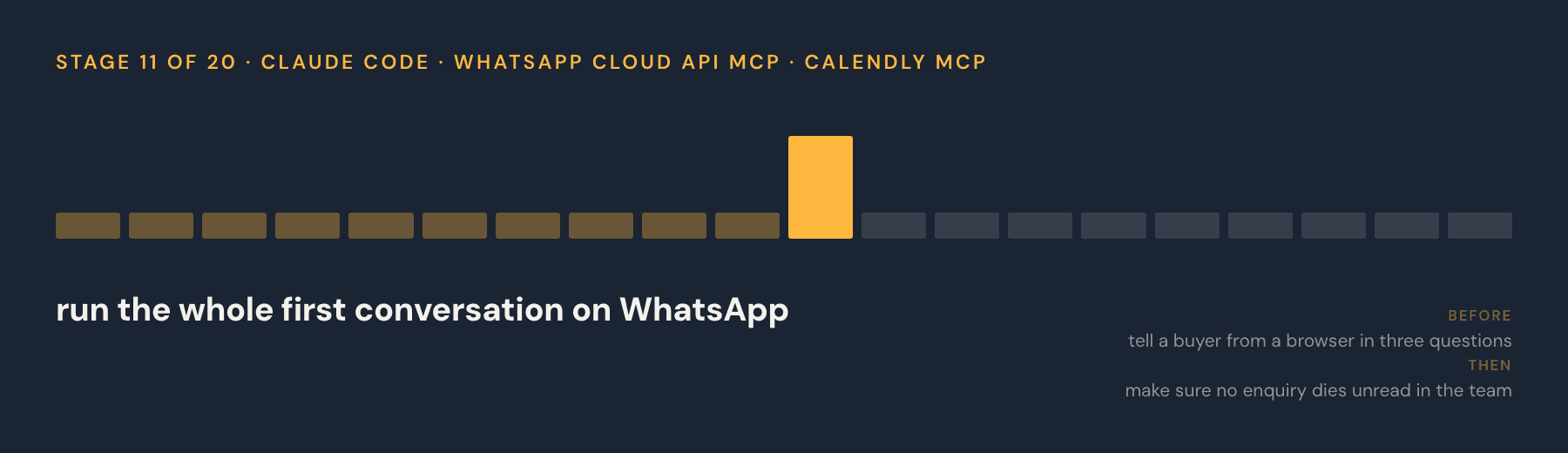
This is stage 11 of twenty, after telling a buyer from a browser in three questions and before making sure no enquiry dies unread. The whole engine in order is the book, Building a real estate sales engine with Claude Code and Codex, end to end.